
Which one is your home? · Outdoor Living
You Have a Patio Nobody Sits On
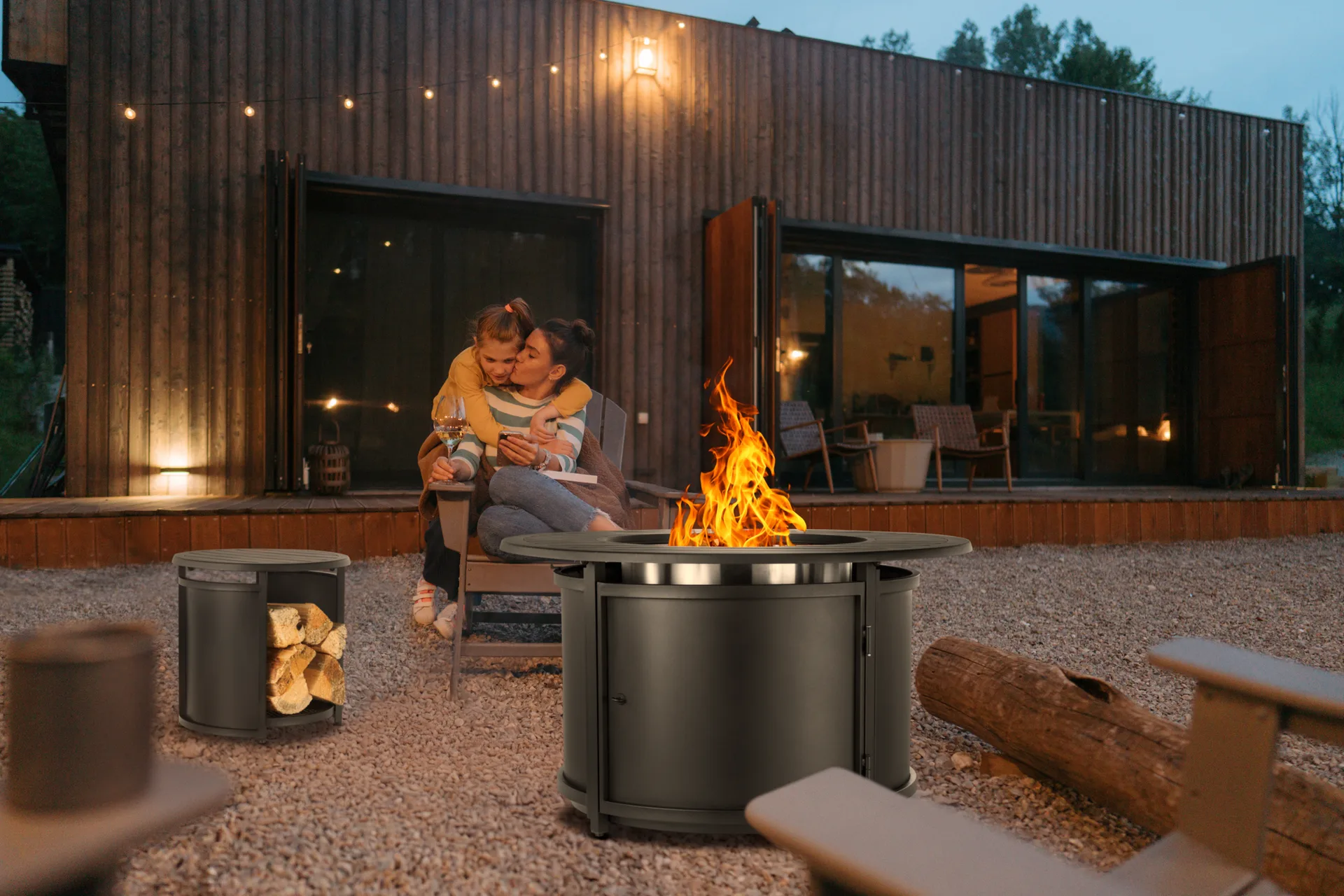
Utah evenings cool off fast even in July. One fire is usually the whole difference.
The product browser didn't load
It's a third-party tool and it isn't responding right now. Everything it shows is also on this page—keep scrolling for the full list, or go straight to your local shop, who can walk the whole range with you.
Situation
The short answer
You have a patio nobody sits on, and in Utah that is almost always a temperature problem rather than a furniture problem—dry air gives up its heat the moment the sun goes down, at any elevation. One fire is usually the whole difference between a patio used after dinner and one that is not. The cheapest version is a gas fire table delivered this week; the most complete is a fireplace, a kitchen and one correctly sized gas line serving both.
In plain language
Four Ways to Put Fire Outside
They solve different problems and they are not interchangeable. Seating shape is the fastest way to tell which one you want.
- Fire pit—the circle
- A low open fire people surround, with heat going out evenly in every direction. It is the social shape and the usual first purchase. Gas lights with a switch; a modern smokeless wood pit gives real crackle with far less smoke than an old fire ring.
- Fire table—the furniture
- The same burner set into a dining- or coffee-height surface so it works when the fire is off. In a small yard where furniture and fire would compete for the same footprint, this is the answer.
- Outdoor fireplace—the anchor
- A weather-rated firebox built into a wall or a structure, throwing directional heat at seating that faces it. It shelters the flame from wind and it reads as architecture. An indoor unit cannot be used outside—the materials and the listing are different.
- Outdoor kitchen—the reason to stay out
- Built-in grills engineered to live in stone, either as a modular island that arrives finished or a custom island built around built-in components. It turns a patio from somewhere you sit into somewhere you cook and eat.
Start here
Start With How You Sit
Seating shape, yard size and how quickly you want it decide this in about a minute.
- You want people in a circle, this month Gas fire pit or fire table
- The yard is small and furniture competes for space Fire table
- You want an architectural anchor and wind shelter Outdoor fireplace
- You cook outside more than you sit outside Outdoor kitchen
- You want a scale no listed appliance reaches Modular masonry
The difference
The Fast Version or the Built Version
Both end with a patio you use. One happens this week; the other happens once and lasts.
| Delivered (pit or table) | Built (fireplace or kitchen) | |
|---|---|---|
| Timeline | Days | Weeks |
| Groundwork | None | Slab, and usually a trench |
| Gas | A tank, or a short line | A line sized for everything |
| Heat | Even, around a circle | Directional and stronger |
| Wind | More exposed | The firebox shelters the flame |
| Moves later | Yes | No |
| Adds to the house | Furniture | Architecture |
Local
Why This Works So Well Here
Dry Air Cools Fast, at Every Elevation
Utah evenings cool off sharply the moment the sun is down, in St. George as well as in Park City. That is the actual reason a patio goes unused after dinner in July, and one fire is usually the whole fix. It is the same 365-days argument as the indoor half of this catalogue, pointed outward.
April and October Are the Months You Buy Back
The shoulder seasons here are long, clear and just cold enough to keep people inside without a reason to stay out. That is a bigger prize than in a mild climate, and it is why building an outdoor space for July alone is the most common way to underspend.
One Slab, One Gas Line, Both Jobs
Fire features and kitchens end up on the same patio far more often than not. Deciding both now—even if the second gets built next year—means one slab and one correctly sized line rather than opening the ground twice.
A Wood Pit is Still Solid Fuel
Air-quality restrictions on an action day apply to a wood-burning pit the same way they do to an indoor wood appliance. A gas pit or table lights on any day of the year, which in a Wasatch Front backyard is a real difference in how many evenings it actually gets used.
What's actually going on
The Part Nobody Explains
This is the half of the year most fireplace sites ignore. Utah lives outdoors—four real seasons, hiking and fishing all summer, hunting in the fall—and yet most patios sit empty after sunset for want of one reason to stay out there.
The range runs from a fire table you could take home today, through a built fire pit, to a full outdoor kitchen with a true built-in grill set in stone. The same shops that fit your indoor hearth build all of it, which matters: it's one crew, one permit conversation, one point of responsibility.
Start with where people already sit. Placement decides whether an outdoor fire gets used daily or twice a summer, and it's the one thing a photograph can't tell you.
How it works
Here's How to Find the Perfect Fireplace
- 01
Browse the Products
Answer a few questions about your room and see the units that actually fit it.
Browse fireplaces → - 02
Find Your Local Dealer
Enter your zip code and meet the shop that serves your neighborhood. One shop, not a bidding pile.
Find your dealer → - 03
Book an Appointment
Showroom visit or in-home. They handle the permit, the venting, and the install.
Book an appointment →
Not quite it?
The Other Four
Find the one that looks like your room.
Talk to Someone Who's Done This Before
Enter your zip code and meet the shop that serves your street.
Questions buyers ask
Questions Buyers Ask
What should I put on my patio first?
A fire, almost always, and usually a gas pit or table because it can be delivered and lit without a build. It is the lowest-effort change that most reliably alters how often the family is outside—which is why these shops treat it as the start of the outdoor conversation rather than an add-on.
Do I need a gas line for outdoor living?
Not to start—a propane tank runs a pit, a table or a grill perfectly well and many units are designed to hide one. If a fireplace or a kitchen is anywhere in the plan, a natural gas line sized for all of it is the better long-term answer, and running it once is much cheaper than twice.
Can I use my patio in a Utah winter?
With a fire, far more than people expect—the constraint here is the temperature after sunset rather than the season. A covered patio with a fireplace gets used into December in the valleys. Snow load and access are the real winter limits, not the fire.
Covered patio or open—which is better for fire?
Covered extends the season and shelters the fire, and it changes the install: clearances to the structure above and where a flue terminates both become model-specific questions. An open patio is simpler and more weather-exposed. Settle the structure before choosing the appliance.
How much heat does an outdoor fire actually give?
Enough to make the seating comfortable, and no more—outdoors there is no room to warm, so everything is radiant. What matters is seating distance and arrangement rather than an output figure: the same fire with chairs pulled in is warm and with chairs pushed back is decorative.
Can a fire feature go on a wooden deck?
Sometimes, with the right unit and a heat barrier underneath, and the clearance to the deck surface is model-specific. It is not a detail to guess at, because the failure mode is scorching or worse. Say it is going on wood at the first conversation.
What is the difference between a patio heater and a fire feature?
A patio heater is an appliance that makes a seating area warm and nothing else. A fire feature is the reason people gather in the first place, and the warmth is a consequence. Most patios that get used every evening have something to look at, not just something to stand near.
How long does an outdoor living project take?
A delivered pit or table is days. A fireplace or a kitchen is weeks, sequenced across the slab, masonry, gas, electrical and countertop. The groundwork and the utilities set the schedule—the appliances themselves go in quickly once everything is ready for them.
Do I need a permit for outdoor living work?
New gas piping does, run by a licensed gas-fitter, and a masonry structure may bring the build into scope as well. A freestanding gas table on a tank normally does not. The shop doing the work tells you which of those applies and pulls what needs pulling.
Should I build it all at once or in phases?
Phases are completely reasonable, and the one thing to do up front is the invisible part: the slab and a gas line sized for everything you might eventually want. Get those right and the second phase is straightforward; get them wrong and the second phase means opening the ground again.