
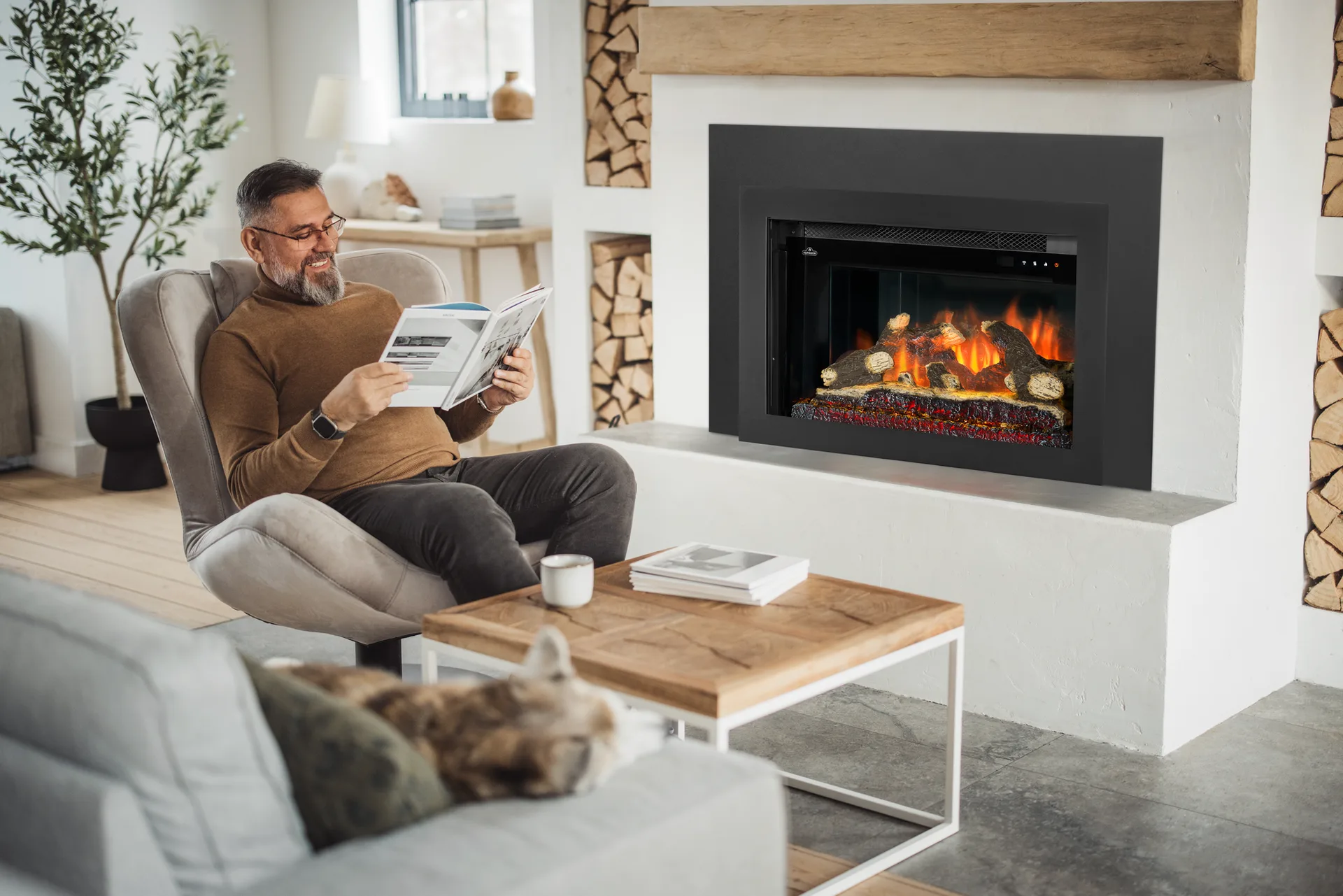
Which one is your home? · Open Fireplace
You Have a Fireplace That Costs You Heat
A masonry firebox looks like a heater and behaves like an open window. An insert changes that.
The product browser didn't load
It's a third-party tool and it isn't responding right now. Everything it shows is also on this page—keep scrolling for the full list, or go straight to your local shop, who can walk the whole range with you.
Situation
The short answer
You have a masonry fireplace with an open firebox, and it is costing you money. An open fireplace is close to break-even at best and often runs negative—it pulls air the furnace already paid to heat straight up the chimney. The fix is to seal that opening with an insert, in gas or wood, which turns the hole in your house into a heater. The cheaper alternative, a gas log set, makes it beautiful without making it warm.
In plain language
Why the Fire Feels Warm and the House Gets Cold
Standing in front of an open fire, it is genuinely hot. Two rooms away the furnace is working harder. Both of those are true at once, and this is why.
- It is a hole in your building envelope
- A fire needs air, and an open firebox takes it from the room. That air was heated by your furnace, and it goes up the chimney along with most of the fire's own output. What you feel on your face is radiant heat; what you pay for is the air leaving.
- The damper is not a solution
- It has to be open while the fire burns, and a traditional throat damper does not seal well even when it is closed. A masonry fireplace that is never used still leaks, which is why a top-sealing damper is a cheap thing to ask about even if you change nothing else.
- Sealing it is the whole idea
- An insert closes the opening with a certified firebox and runs a stainless liner up the flue. Now the fire draws outside air, the chimney is no longer a chimney for your house, and the heat comes into the room instead of leaving.
- Four measurements decide what fits
- Front width, front height, back width, and depth. A masonry firebox tapers, so the back is almost always narrower than the front—that is the number people forget and the one that rules units out.
Start here
Three Honest Answers, Very Different Prices
What you want the fireplace to do decides which of these you are buying.
- You want it to genuinely heat the room Gas insert
- You want wood heat, and no gas line Wood insert
- You just want it usable and good-looking Gas log set
- The masonry is failing or the shape is wrong Tear out, build in a zero-clearance unit
The difference
Seal It, or Just Make It Work
The two routes people actually choose between, side by side.
| Insert (gas or wood) | Gas log set | |
|---|---|---|
| The flue | Sealed, with a liner | Open while burning |
| Heats the room | Yes | Barely |
| Stops the air loss | Yes | No |
| Look | A finished appliance behind glass | Closest thing to an open fire |
| Cost | The larger project | A fraction of it |
| Reversible | Not easily | Yes—it lifts out |
Local
What This Means in Utah
A Long Heating Season Makes the Air Loss Expensive
The efficiency argument for sealing an opening is not abstract in a state where the furnace runs from October to April. Every hour an open fireplace burns, it is competing with the appliance you are already paying to run.
An Open Masonry Fireplace Cannot Be Used on a Red Day
Along the Wasatch Front, solid-fuel burning is restricted on air-quality action days, and an uncertified open fireplace is squarely in scope. If you have a fireplace you cannot legally light on the coldest, stillest nights of the year, a sealed gas insert is the direct fix.
Get the Chimney Looked at Before You Spend Anything
A lot of Utah housing stock has fireplaces that have not been swept or inspected in a decade or more. An insert does not fix a failing liner, a cracked crown, or bad flashing—it just gives you a reason to find out. Every shop in this network will look before quoting.
What's actually going on
The Part Nobody Explains
An open fireplace consumes air. It takes air your furnace already paid to heat and sends it up the chimney, which is why the room feels warm and the back bedrooms feel cold, and why the house is often cooler after the fire goes out than before you lit it. Even with the damper shut, it leaks.
An insert fixes it three ways at once. It seals the flue so the house stops losing air, it radiates heat into the room through the glass, and most models add a fan that pulls cool room air around the hot firebox and pushes it back out warm. Your home is more efficient before you light the first fire.
The Four Measurements that decide which units fit are front width, front height, back width, and depth. A masonry firebox tapers, so the back is almost always narrower than the front—bring all four to the showroom, or have the shop come measure.
How it works
Here's How to Find the Perfect Fireplace
- 01
Browse the Products
Answer a few questions about your room and see the units that actually fit it.
Browse fireplaces → - 02
Find Your Local Dealer
Enter your zip code and meet the shop that serves your neighborhood. One shop, not a bidding pile.
Find your dealer → - 03
Book an Appointment
Showroom visit or in-home. They handle the permit, the venting, and the install.
Book an appointment →
Not quite it?
The Other Four
Find the one that looks like your room.
Talk to Someone Who's Done This Before
Enter your zip code and meet the shop that serves your street.
Questions buyers ask
Questions Buyers Ask
Is my open fireplace actually losing me money?
Almost certainly while it is burning, and possibly while it is not. An open firebox draws heated room air up the flue, and a traditional damper does not seal well even closed. The fire feels hot because it is radiating at you; the house gets colder because the air leaving is warmer than the air replacing it.
Will an insert ruin the look of my fireplace?
It changes it, and how much depends on the surround you choose. A steel surround covers the gap between appliance and masonry, and sizes are finite—which occasionally decides the model. If the masonry itself is the thing you love, say so early; it narrows the list to the units that sit furthest back and show the least frame.
Do I need my chimney inspected before installing an insert?
Yes, and it is not an upsell. The liner, the crown, the cap and the flashing all have to be sound, because the insert vents through that flue for the rest of its life. Finding a problem before the appliance is ordered is a great deal better than finding it during the install.
Can I keep burning wood after an insert goes in?
Only if the insert is a wood insert. A gas insert and its liner occupy the firebox and the flue and the opening is sealed. If burning wood some of the time genuinely matters to you, that decision has to be made now rather than later.
What if I do nothing?
A perfectly reasonable answer, and the cheapest improvement is a top-sealing damper—it stops the year-round air loss from a fireplace you rarely light, for a small fraction of an insert. If you use the fireplace twice a year for the look of it, that may be the whole project.
How do I measure my fireplace opening?
Four numbers: front width, front height, back width, and depth, measured inside the firebox. The back width is the one people miss because a masonry firebox tapers toward the rear. Photograph the opening as well, and bring both—fit gets confirmed in about a minute with all four.
Is it cheaper to seal the fireplace or to replace it entirely?
Sealing it with an insert is nearly always the cheaper route, because the opening and the flue already exist—there is no framing and no drywall. Tearing out masonry to build in a zero-clearance unit is the answer when the masonry is failing or the opening is the wrong shape for anything you like.
Can an insert go into a prefabricated metal fireplace?
Sometimes, and it needs checking rather than assuming—many inserts are listed for masonry only. Photograph the data plate inside the firebox and take it to the showroom. That plate answers it in one look.
How long does the work take?
Usually a day. Liner down the chimney, insert in, gas connected and tested, surround fitted. Because the masonry is already there, this is one of the least disruptive projects in the catalogue—no framing, no drywall, no dust through the house.
Will sealing the fireplace make the rest of the house draughty?
The opposite, usually. A chimney is a hole at the top of a heated volume, and closing it removes a route for warm air to leave and cold air to be pulled in behind it. If a house has genuine make-up air problems, an installer will spot that while looking at the fireplace.